Politics As Usual
Why do some still pretend this process is working for us?


Recently, while making breakfast, my inner dialogue was interrupted by an unexpected and somewhat urgent knock at the door1. Frustratingly, it wasn’t those annoying people from the People’s Postcode Lottery informing me that I’d just won a substantial sum of money; instead, it was someone from or associated with the Labour Party practically begging for my vote in the upcoming local elections, or else another pesky party might seize power in my area.
While in the middle of their rehearsed spiel, I informed the polite, softly spoken individual that I didn’t engage in political activity such as voting, so they were wasting their breath. Unfortunately, this didn’t bring the abrupt end to their pitch I was hoping for that would save my eggs from burning, so, eventually, I took their leaflet as an indication that I might participate in this circus they call political democracy.
This interaction got me thinking about how so many are still heavily invested in the political theatre and what the reasons for this might be. One is that so many careers depend on it—think about the entire political ecosystem, which includes commentators, analysts, political staff, and the politicians themselves—but another might be people's inability to imagine living under a different structure. People don’t take the time to think about what it actually means that, at the highest level of politics, it is all rigged against us, and because so many only passively observe the political stage show, it’s difficult for them to remain engaged long enough to consider alternatives.
I’m no “political expert”, but just employing simple logic (and taking a glance at history) leads me to the conclusion that there’s no such thing as ‘democracy’2 as it’s presented to us. If one manages to claw their way to a position of power (and I don’t just mean politically, it could be financially, or any unseen position of influence above any democratic policies), why would they ever create conditions where that power could be taken from them? What if, in an election, for example, the people vote for something or someone (more on this later) that reduces their influence? Why would they bother doing the things it takes to gain power if they don’t use that power to maintain it? People who strive for supremacy don’t often want it for a short, limited time.
The easiest comparison I can think of is the relationship between an adult and a child, which is apt because the general public is treated like children. Would a parent ever give a child any consequential decision-making ability, or would they instead pretend they’re being given a choice so as to quell any potential tantrums?
Exactly. This is what I’m saying.
Yet, people still believe that their votes count or make a difference to the overall picture. However, it is slightly reassuring that some people are beginning to openly question the reality of our political situation:
“I’m afraid it taps into that very deep feeling of, you know, the people we vote for are not the people who are running the country. The people who we vote for are the front face, the shop window, but there are these unknown, unelected, highly paid, very influential, and clearly, more powerful than the prime minister ... It just makes you feel deeply uncomfortable, Caroline, about the dysfunction, and indeed, as you belie there, this feeling that we see the tip of the iceberg. We think we’ve got a democracy that’s open and fair—we don’t.” — Ranvir Singh3
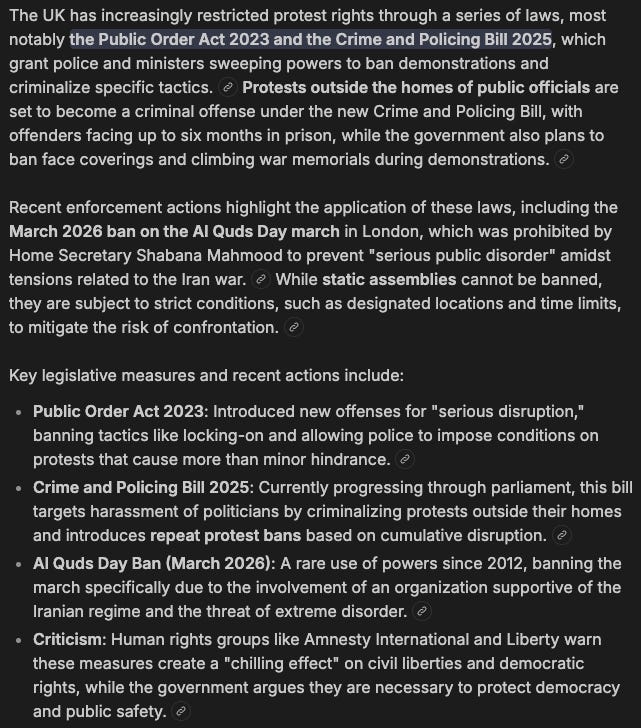
Do you genuinely think they let We, The People, influence anything of significance? The people/party selected to be in power are indebted to the people who actually helped put them in that position (e.g., financial donors), not us. Public petitions against certain notions with hundreds of thousands, even millions of signatures, are ignored. Protests are ignored, and their potency is increasingly diminished4 without our democratic consent. The will of the people is always ignored, because of course it is. Why would you give the children any consequential decision-making ability?
I remember my dad and some of his siblings getting onto me because I said I wasn’t going to vote in a past election. “People died so you could vote”, they told me. Well, I guess they died in vain, because they were fighting for a democracy that didn’t and doesn’t exist. The fascinating thing to me is that the thought of opting out of a system that is so blatantly corrupt was so alien to them. How much observable corruption would it take for those who have faith in these organisations to conclude that maybe, just maybe, they aren’t fit for purpose? Because history (the present, and probably the future) is littered with examples that you would assume would change people’s perspectives, yet here I am being disturbed by door-to-door political party campaigners pleading for my vote.
A further example, as if I needed to cite one, is in the countless countries that have a leader or political party that certain other countries don’t agree with, so they create the conditions to overthrow said leader/party, in a brutal demonstration of our beloved democracy.
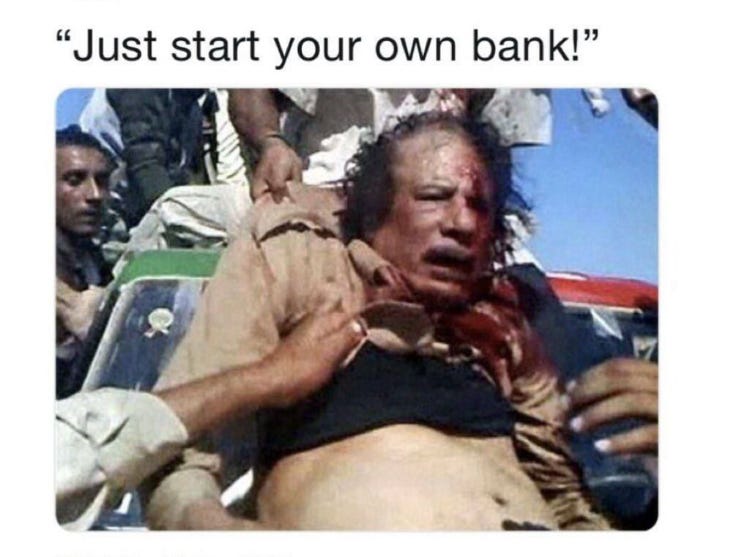
Thankfully, the technocrats will soon suggest replacing the illusion of democracy with AI algorithms that decide what is best for a global society. I wonder if we’ll get to vote on that?
Politics as usual, it seems.
Isn’t it funny how if you’re not expecting a visitor, any knock on the door is treated with unhealthy suspicion? Who the fuck is this showing up uninvited?!
a system of government in which power is held by elected representatives who are freely voted for by the people, or held directly by the people themselves
Link to a clip taken from ITV’s Good Morning Britain.