Dating Apps and the Digitalisation of Love
I took a deep dive into the shallow end of the online dating pool

Almost every way we now interact with the world has become unnatural as a result of technological advancement. In capitalism’s unrelenting course of commodifying everything, society seems to have taken a style-over-substance approach to life.
— The Internal Outlook
While searching for something in the nether regions of my email inbox, I fortuitously came across an essay written and sent to me by a friend in 2015, titled What Tinder Taught Me. Within the thorough, yet unfinished draft they shared, the male author in his early twenties described his experience using Tinder for the first time, which evolved into a scathing assessment of how people attempt to find real-life love in an increasingly digital environment.
For those who don’t know, Tinder is a dating app launched in 2012, marking one of the most successful forays into apps of its kind that targeted a younger adult market. So, What Tinder Taught Me was an early observation of the behaviour exhibited by those dating online in the nascent years of this digitalisation of romance, written by someone who had been seduced by the alleged ‘tool that would soothe the bitterness of an unavoidable break-up and reintroduce [them] into the dating world’.
After discovering this trove, I used the analysis provided as a starting point to compare it with today’s online dating behaviour, where it is even more socially accepted (and often encouraged) to seek relationships via pixels and prompts on a phone screen. I sought to develop a greater understanding of any behavioural patterns and to see if trends identified in What Tinder Taught Me had consolidated themselves within the digital dating space, as well as what new tendencies had become popular as this way of life becomes increasingly normalised.
Before all that, though, I had to create a profile on a dating app to conduct my research—I chose Hinge because, c’mon, it’s 2025—and though I’d used them sporadically in the past, I had avoided dating apps, as the experience always left me with a sense of unease. I think this is chiefly due to it feeling so disingenuous when compared to real-life human interaction of a romantic nature. I also don’t take selfies, so I don’t have enough (sexy) pictures of myself to fill a profile.
It’s not because I’m ugly, though.
I’m not ugly.
I’m not.
I’ve got the sort of look that’ll make you double-take, but then be disappointed that you bothered looking again.
Anyway, this isn’t even about me; this is about the rediscovery of a friend’s forgotten think-piece.
The introductory paragraphs of What Tinder Taught Me outline the events that led to its examination of the online dating pool, as well as the initial thoughts on the experience:
During the thirty seconds that the app took to download and install on my phone, I found myself lost within a stream of optimistic fantasies; women of beauty and intellect would dance around the frontal lobe of my brain and then proceed to drag me further into a perfect dreamscape of sex, companionship and unlimited conversation. This app was to be my redemption.
Yeah, that does sound wonderful; however, that optimism soon diminished as the reality of the situation eventually became clearer:
I chatted to a lot of women and went on a few dates, but they never really amounted to anything. I reflected on this and thought that I may be the problem. I discovered that my fantasies about the app had been centred around a utopian vision of the decline of inhibition and a frank disregard for normal social convention, which I hoped would result in a primal sex fest. It was a facile and infantile philosophy to hold.
Do you think that most men still approach dating apps in the same way today? In defence of this outlook, I remember that this was the main attraction to Tinder at the time for most men of a similar age. A catalogue of women who were DTF1 simply because they appeared on the app; it was a tantalising, well-placed lure.
What Tinder Taught Me begins its social analysis by focusing on how users introduce themselves to potential matches, admitting: ‘In an attempt to vindicate myself from the shame of approaching the app like a shallow misogynistic sex pest, I decided to take a step back and look at it from a more objective and less goal-oriented perspective; anthropologist hat firmly on.
‘I began to look at the women that the app presented me with through a more analytical lens. I wanted to study how they considered and presented themselves to prospective matches,’ the essay asserts, before offering a list of examples2 that it describes as ‘startling’.
Initially, I thought little of this and accepted it as typical Tinder, yet after reflecting, I found that they are truly abhorrent. Consider the bio that reads “Art, music, beer, coffee, travel”—it is so cripplingly nebulous that it verges on parody. This woman has decided to define herself through five words that cover such a broad spectrum of past times and interests that pretty much any prospective match could attest to having something in common with her. Was this her intention? Possibly; probably. Identifying yourself through such cultural norms and universally accepted and desired interests seems so pointless, so lazy.
Sheesh. Tough start.
Of all the things mentioned in that cited biography, a subject that is taken to satirical levels on dating apps is travelling, something that What Tinder Taught Me is seemingly seething about:
To further highlight how lazy and short-sighted these people are, you need only consider the fact that 47% of the sample bios above choose to express their personality by revealing they like to travel. Nearly half! Travel is something universally desired. It is something that is so normal and so easy to accomplish that I genuinely could not understand why this makes a Tinder profile different or even desirable. The travel that they want you and me to think of is one of exotic mystery, philanthropic grandeur and self-discovery, but the reality culminates in one or two of the following episodes: an awkward trip to Rhodes watching their parents get roaring drunk on sangria; a debauched jaunt to Magaluf; a serotonin depleting venture to Ibiza or touching an anaesthetised tiger cub in a Thai zoo/prison.
Though it’s difficult to disagree, I suppose one of the differences now is that some may have added an increasingly cliché trip to Dubai as one of their Instagrammable destinations.
As amusing as this What Tinder Taught Me passage is, it includes a seriously damning indictment of one of the most common dating app tropes that has stood the test of time, because in 2025, the mention of travel is possibly the most recurring theme I’ve seen. And that’s saying something, too, because it has some fierce competition.
The topics3 I’ve seen women refer to most often are the aforementioned wanderlust, revelling in the consumption of alcohol (way too often spicy margaritas) or food (foodies), the desire for princess treatment, their preferred love languages, and emotional intelligence—a concept that I suspect most don’t have an accurate grasp of.
In an attempt to combat this sense of duplication, dating apps such as Hinge have tried to focus users’ expressive energy via the use of prompts that set a parameter for what should be said, such as:
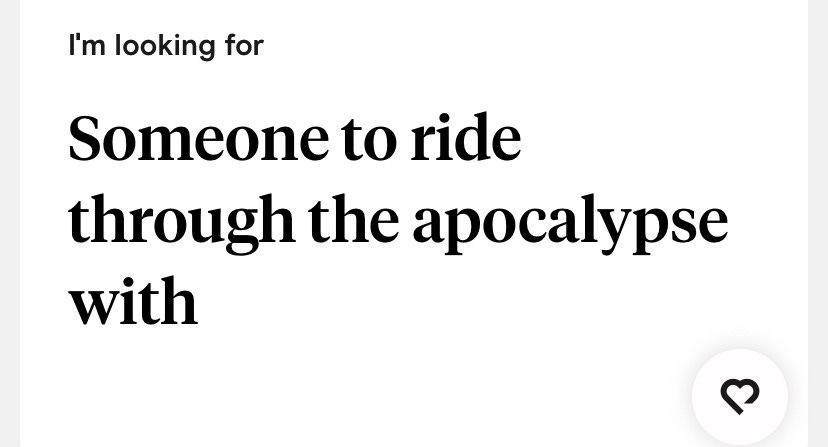
I’m looking for…
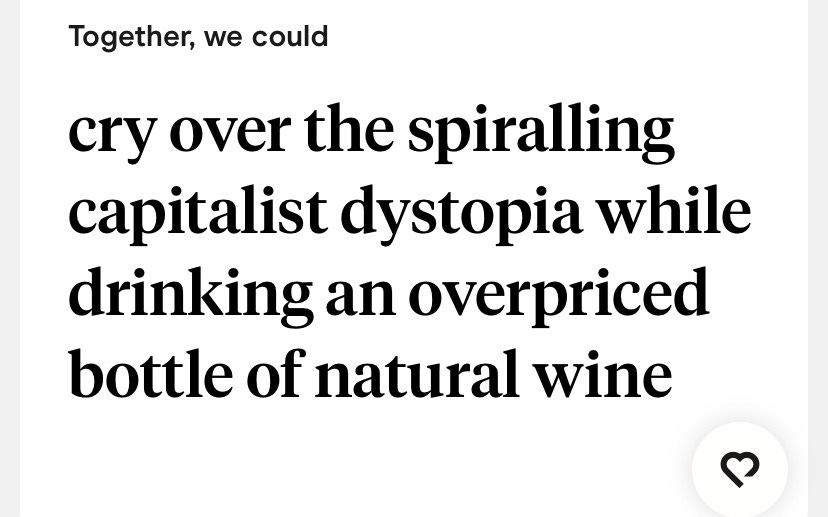
Together we could…
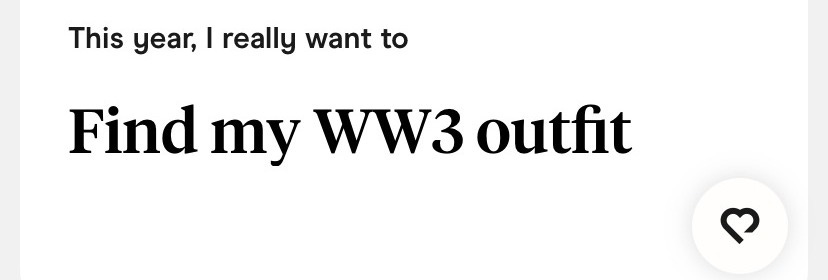
This year, I really want to…
I think this was a sensible decision, mostly because it alleviates the degrading feeling of having to write a personal statement or a come-and-get-me plea to countless strangers, but also because prompts can be fertile ground for showing a bit of individuality. So, you can imagine my disappointment when I came across these examples from two different women.
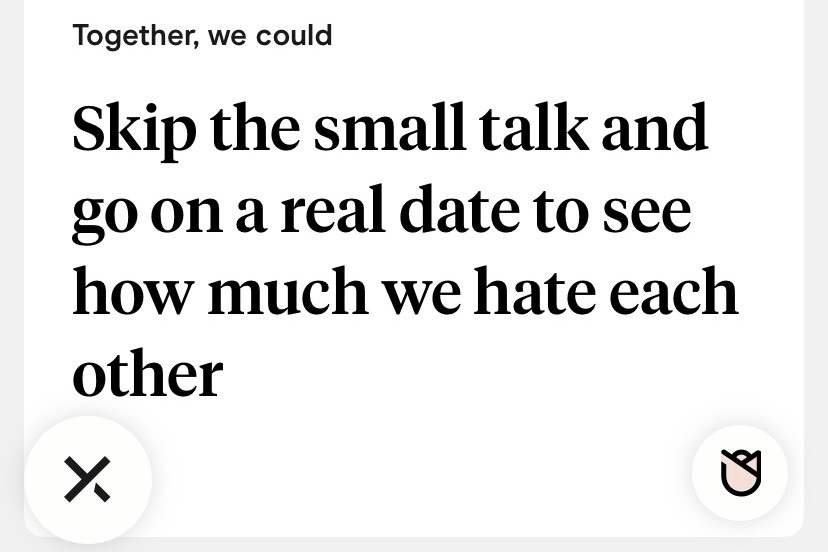
And,
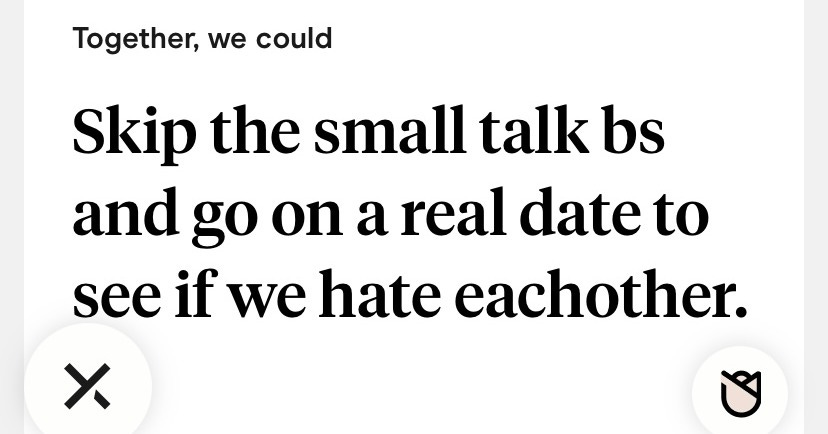
Obviously, there’s only so much of your personality you can force into the space afforded (and I don’t just mean because of the 150-character limit), but they’ve even selected the same prompt, which makes this feel like I’m challenging you with a spot-the-difference puzzle (remember those?).
It has been suggested that one of the reasons women struggle to express their personality productively4 is that, especially among the more attractive women, they often don’t need to develop one that a man will value; instead, sheer physical beauty can usually do most of the work when initially attracting a partner.
And, much like in real life, on dating apps, the courting is usually initiated by men anyway, and they must conjure comedic genius from scraps such as this just to set themselves apart from the competition:
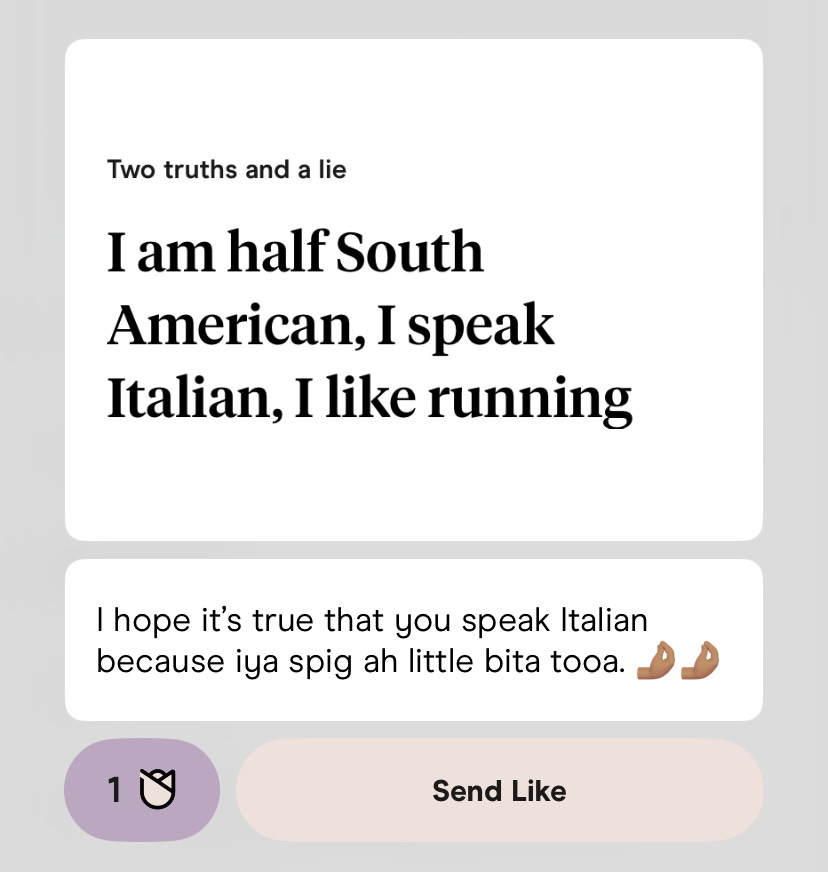
The rest of the bios listed regurgitate gut-wrenching clichés, strained expressions of personality, or overwrought and aggressive sentiments that are meant to make other people like them. It is nauseating.
Of course, some users completely ignore the prompts and, often expressed with a full stop or ellipses, just post pictures colloquially described as thirst traps5. I admit, there were more than a few exclamations of ‘Bumboclaat!’ and ‘Lord, have mercy!’ when I was shown some of these pictures as bait, designed to play on my instincts—but that’s the whole point. They’re trying to trap us through our thirst, but we must stay focused, brothers, we must stay focused!
And no, obviously, I won’t show any examples of any thirst traps here, you can use your imagination…or just open Instagram, which brings me aptly on to a recent addition to women’s online dating vernacular: leaving their Instagram6 handle (or, if they’re under 23, their Snapchat) somewhere on their profile. Why prioritise a real relationship when you can have a parasocial7 one with your social media followers?
Furthermore, as I carefully walk the tightrope above rant territory, the desensitisation to seeing women half-naked pretty much everywhere nowadays should be alarming. Generally, women used to dress and act more modestly8, so how the opposite has been normalised is wild if you think about it, instead of just shrugging it off as some sort of natural, societal progression that nobody had influence over. Granted, it may benefit some on an individual level, but it certainly doesn’t benefit society as a whole.
Now, I can imagine some readers saying to themselves words along the lines of: They’re just pictures of her on holiday, and she’s on the beach; of course she’s gonna be wearing a bikini, you misogynist, or whatever, and I hear that, but I can see it, and I’m not on a beach, I’m on a toilet. And these pictures aren’t on the beach, they’re on the internet.
Look, we’ve all had our fun, but if we could stop sipping from the chalice of supposed female empowerment for just a moment, our collective taste buds might have a chance to reset and remind us what moral decency feels like on our tongues9. I suppose seeing half-naked women on a dating app is slightly more appropriate than seeing them on social media or the street. See, this glass is half full!
Anyway, digression aside:
People on Tinder paint a highly distorted picture of themselves that they assume is attractive, but the fact that they do not even attempt to consider anything outside of their own experiences is a damning and reductive thought process; it results in a pathological need to be wanted or pandered to and stops people from looking constructively for a like-minded individual.
This feature of online behaviour has only intensified since social media’s psychological wizardry cast a narcissistic spell over most of its users. While, in dating terms, it’s resulted in the Disneyfication of relationship expectations, with some women demanding ‘princess treatment’ despite showing few signs of being a princess. Take, for example, this Hinge user who warned:
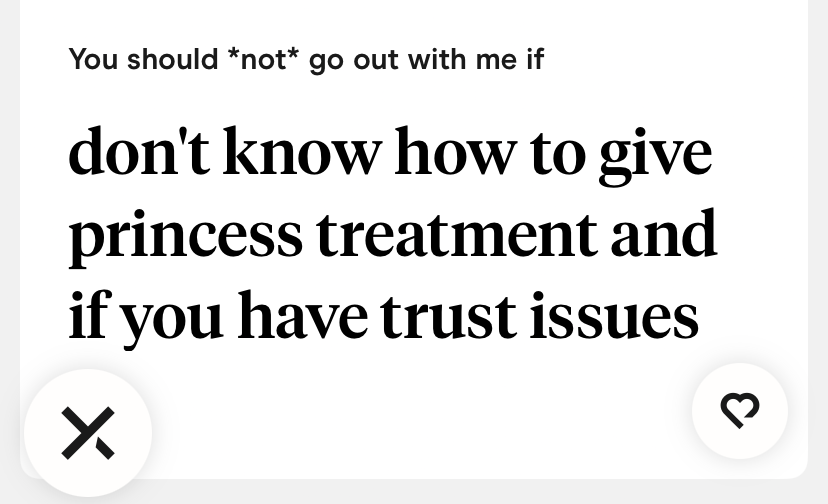
Some women don’t seem to realise that most men know how to treat them like a princess—it’s similar to how you would treat a child; it’s just that they’re selective with who gets that treatment, or they should be, anyway10.
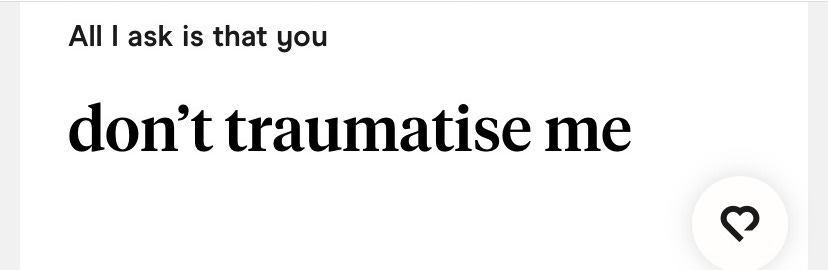
This aggressive stance from women toward the subject often helps make decisions easier for men, as do claims like this from a thirty-year-old mother:
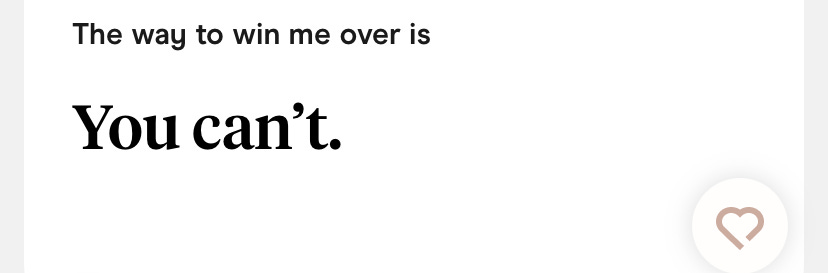
Fair enough, though it does beg the question as to what they expect to gain from being on a dating app. This sort of combative attitude11 is not conducive to a successful, long-term relationship.
Something else that some men don’t appreciate manifests in women who avoid confirming whether or not they have children, despite having the option to via the app (and their conscience)12. You’re on a dating app, but don’t want to reveal if you have children, as if it’s irrelevant? What are we doing here? Yeah, I know it’s up to her whether she wants to disclose such information, but we have to view it in the context that they’re trying to attract a romantic partner—a process these women choose to begin with unnecessary deceit. How do they think a man is going to react when she finally lets slip that she’s raising another man’s child?
While at the other end of this confusing spectrum are those who put their children centre stage in their dating lives:
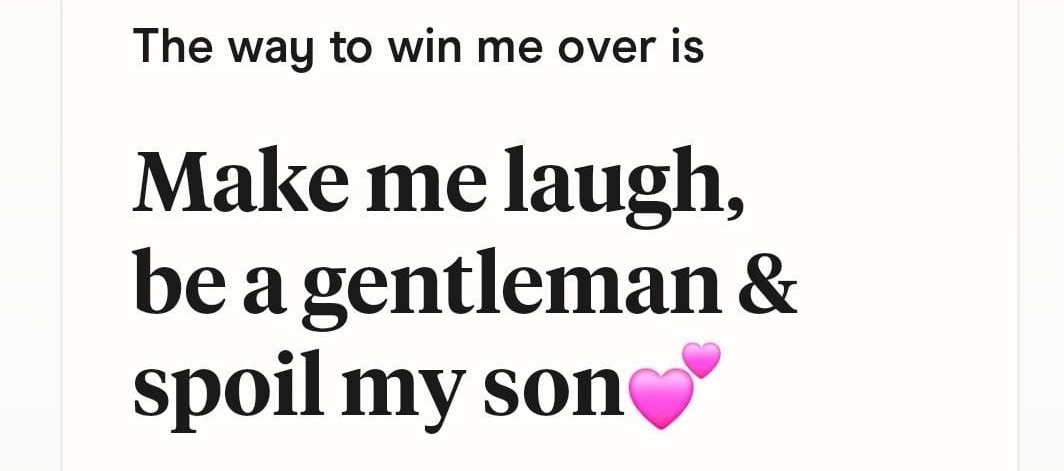
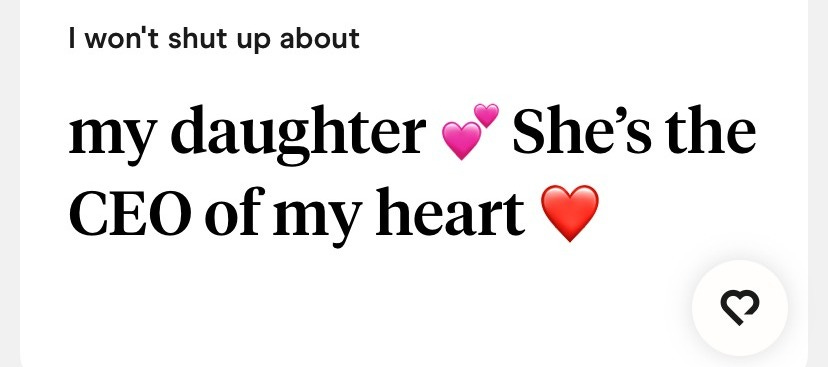
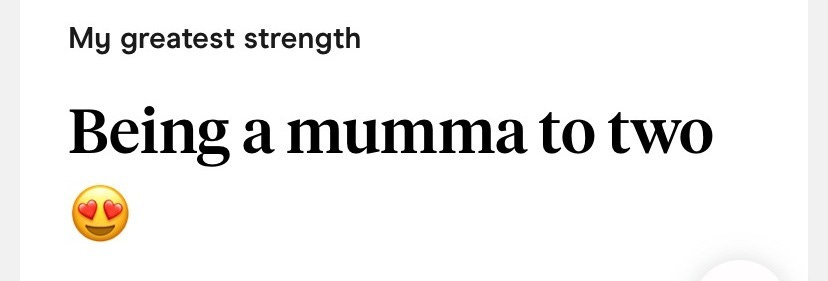
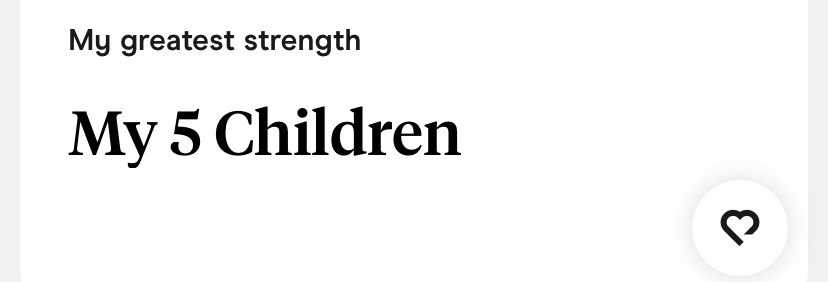
Men will appreciate the honesty, if not the way it has been executed in these examples, as we respectfully click the ‘X’ button. Surely there’s a middle ground between these two extremes?
There’s also a subgroup of women who advertise the desire for their partner to be ‘obsessed’ with them. It’s worth noting that this is energy usually emitted by younger users (circa 18-25), but is certainly not exclusive to that age group (where my immature ladies at?!). Is it just tongue-in-cheek? Quite possibly, but if not, it reeks of what What Tinder Taught Me threatened to expose.
Look no further than the bios that read ‘Rest in paradise nanny&granddad my angels <3’ and ‘Love my girls Sarah and Lianne <3’—what have these people hoped to achieve or reveal about themselves here? The first one that reads like a funeral script made up of flowers is wholly inappropriate and is in no way relevant to a dating app; it is just plain sick. Likewise, the second one that vomits sycophantic vitriol is almost as bad as the lost epitaph that precedes it. These bios consider nothing but their own immediate concerns and desires and confidently assume that it will garner matches.
Unorthodox female mating calls are still prevalent13, and, albeit not (always) as ‘wholly inappropriate’ as the cited profiles in What Tinder Taught Me, the most common improper conduct of today's dating app users is a sign of how women have become more overt about their dating requirements in recent years.
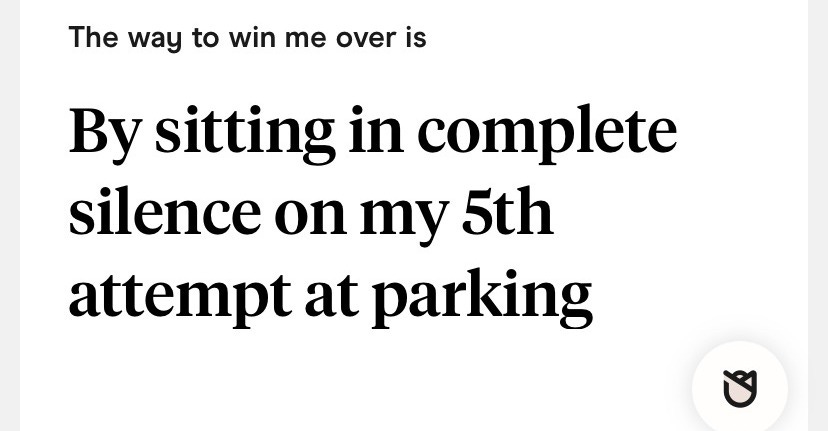
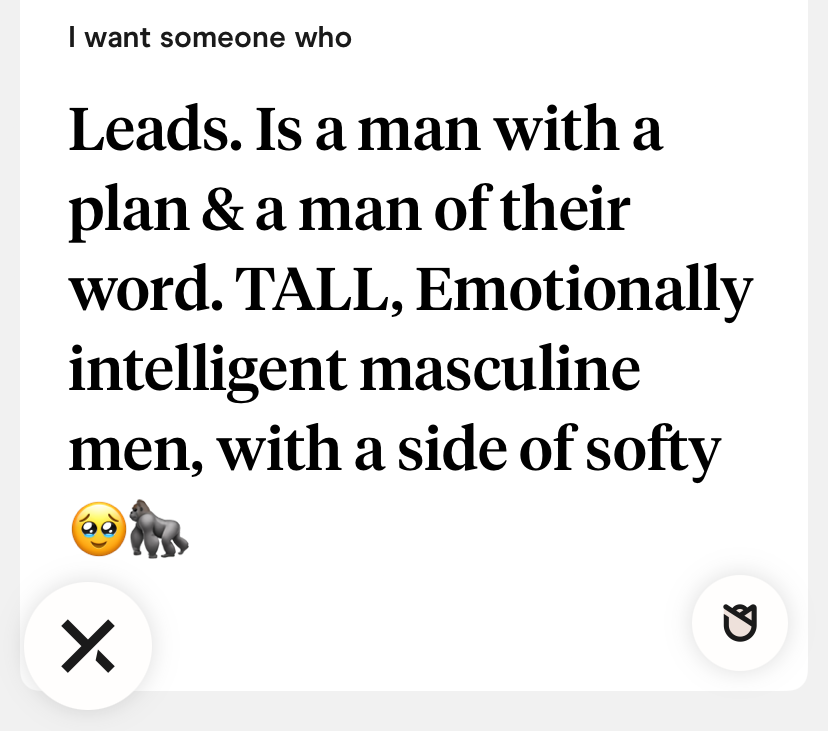
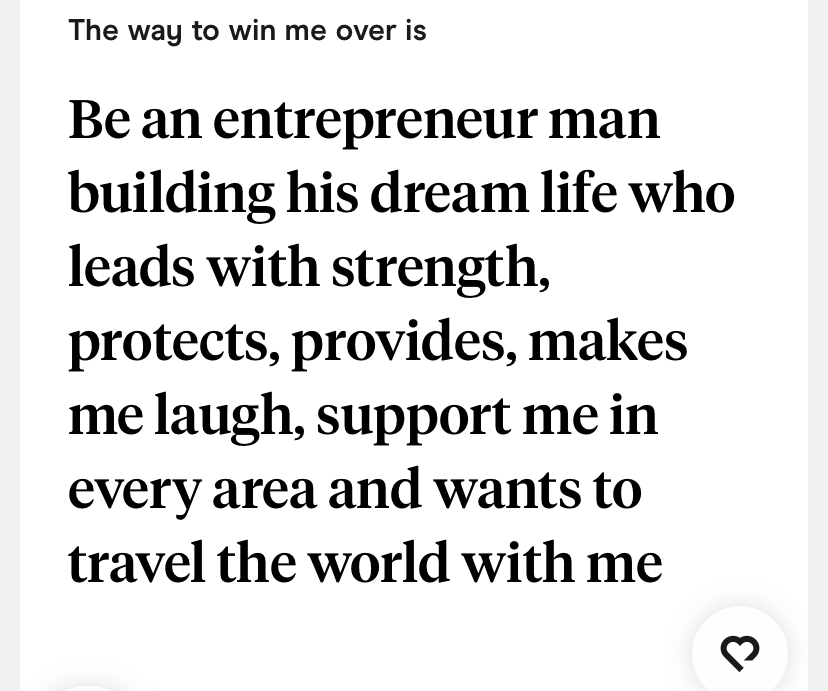
‘I want someone who…Leads. Is a man with a plan & a man of their word. TALL, Emotionally intelligent masculine men, with a side of softy14’, requested this particular user, who is certainly not alone in her adoption of this self-centred approach to courtship, as another with a comparably adamant nature stated: ‘The way to win me over is…Be an entrepreneur man building his dream life who leads with strength, protects, provides, makes me laugh, support [sic] me in every area and wants to travel the world with me15’.
I want you to read those lists of demands again. I thought we were trying to fall in love, I didn’t realise some women expected this to be like ordering a man from Amazon. To put it bluntly: men don’t care what you want. We don’t care what you want, ‘cause we can only give you what we have. For us, using dating apps is like applying for jobs—we don’t just apply for one job at a time that we think we’re suited to, we use the scattergun approach and hope we hit something. And no, technically, we might not fulfil all the requirements, but we’re still going to apply anyway, because why not?
Most of what is written in these outlandish tirades—though often wildly unrealistic—isn’t that appalling in isolation, but once we apply the context that they’re trying to attract someone, the view does become murky. Though many who express these views online may not necessarily uphold them in real life, each time I encounter another woman spouting similar platitudes, it erodes my belief that relationships are moving in a healthy direction. There seems to be a distinct sense of entitlement due to the abundance of attention women receive on digital platforms, personified through likes and comments, which has been mistaken for viable options for long-term commitment.
The simple fact of the matter is, people use Tinder as a keepsake for their own vanity; it is a botched exercise in their own egotism and a very public display of their need to be fucked, both literally and figuratively, by a matrix of vapid social limpets.
As you can probably tell by now, What Tinder Taught Me is descending toward the pinpoint of one of online dating’s and, perhaps, modern society’s fundamental flaws. If people are rewarded, financially or otherwise, for egotistical behaviour, how do you think they’re going to act?
If you’re self-aware enough, the longer you mindlessly swipe through different characters, the more likely you are to feel a toll on your spirit, not necessarily because there aren’t good options among the pack, but more so because of the method of discovery. There comes a point when it doesn’t even feel real anymore—it’s just a game16, or should I say, the gamification17 of human interaction. We’ve started treating each other like Top Trumps, trying to win the game of Love™.
Every word written and every picture taken is strategically considered to conjure a mirage; something that is very easily seen, but dissipates when scrutinised by reason or the very real prospect of reality. People want to be liked, envied and idolised; Tinder effectively capitalises on the most latent and base desires rooted in people’s subconscious and forces them to thrust ‘an idea’ of themselves into the public domain. It then watches as people tear themselves apart by attempting to flirt behind a Venetian mask of maddening insecurity and unfulfilled primal urges.
And how else do dating apps now exploit ‘the most latent and base desires rooted in people’s subconscious’? The only way possible in this day and age—by commodifying everything, and love is no exception. Around the time What Tinder Taught Me was written, most dating apps were free to use without any features hidden behind a paid subscription option, but this, unsurprisingly, is no longer how it works. Our collective yearning for love has been morphed into an exhibition of self-obsessed activity that diminishes the unexplainable sensation of romance, and trades authentic human connection for bikini pics and algorithms. Hey, maybe that’s what love is, you know?
When primarily conducted online, dating is in danger of becoming another consumerist venture in self-indulgence. It could be argued that this has long been the case, but these examples were usually reserved for the elite level18; however, this mentality has now seeped into the general population19.
Take this excerpt from Professor Jiang Xueqin’s analysis of modern consumerism, and note how this same way of thinking can bleed into other areas of modern life: ‘Consumerism creates a competition in society for prestige. To see who can post the nicest social media pictures. This leads to the individualisation, or the optimisation, of you. In other words, you are now unable to act together. You don’t want to organise, you don’t want to act in solidarity. And, ultimately, this means that you develop economic logic.
‘What is economic logic? It’s to see the world only through the lens of capital. Does that make sense? So, when you see someone [and ask yourself], “Do I wanna date this person?”, you don’t ask, “Oh, is this person a nice person?”; you ask yourself, “How much money does this person have?” You use economic logic in order to understand the world, and to reason and analyse the world … Is this how the world works? The answer is yes. Are you like this? Yes, you are like this. You’ve been brainwashed into thinking that this is the only way to behave and to think.’
So, if attitudes toward dating adopt similar characteristics, what effect is that going to have? If we can browse through potential partners like we would clothes on a rack, swiping until we find something we deem worthy of trying on, and, if they're lucky, keep, how is that going to inform our attitude toward relationships? There is a disposable attitude toward human connection that has seemingly taken root and arisen in today’s dating culture, leaving participants with little option but to protect themselves by adhering to the norms (e.g. ghosting), even if these are counterproductive to finding companionship. This makes the psychology behind online dating fascinating.
Studies in human behaviour support the idea that we shouldn’t have to make as many choices as we do20, whether that be brands of food, clothing, or romantic partners. People used to be fairly limited in who they could meet, often curbed by their location, but now, dating apps allow us to sift through candidates within a 100-mile radius of wherever we are, giving the impression of an endless conveyor belt of options. For some, this just might be the case, but to the average dating app user, it certainly isn’t—but don’t think that stops people from acting as if it is.
Tinder has surgically removed the awkwardness that lies in trying to ascertain whether someone finds you sexually attractive or not, and therein lies the root of its appeal: a complete lack of shame.
In today’s dating marketplace, initial, in-person interactions with romantic intentions are not as common as they used to be due to technological and cultural change21, with the comparative ease of online interaction being the preference for most. It could be argued that some people are more comfortable interacting online instead of in person, and can sometimes be better at communicating via a screen (emojis used to be known as expressions), which makes real-life interactions with romantic intentions less common and, therefore, more surprising whenever they do occur22. And now, people are recognising how this is impacting dating.
‘Has [online dating] taken away from the actual phenomena of men and women just interacting?’ asked Gabriel Sion during a conversation about the current state of relationship dynamics. ‘Because now, I can go out—not screw-face guys the whole night, and not screw-face girls the whole night—I can go home and get my gratification from my phone.’
This is a development also acknowledged by Iddriss Sandu, who, during a conversation with 19 Keys, expressed: ‘You text somebody, you see the three dots, they think of a reaction, they either respond in that moment or they ponder, then they go do something else. So, we've been able to divert from real-time interaction, and that's why when you think about a newer, younger generation, the idea of going on a date or asking a girl out or whatever it is, is so challenging and so hard because it's like, I don't have that delayed response. This person is looking in my eyes across this dinner table, and I have to think about the next thing, or I don't even know what she's going to say, right? So people have now deferred, and everything has been a deferment.’
This juxtaposition between online and offline was similarly discussed on a panel about whether there is an existential crisis affecting young people. During a talk presented by The Institution of Art and Ideas, journalist Myriam François shared: ‘I think social media promised us connection, and I think what it has done instead is create greater isolation … The point is that these are spaces where interactions are commodified, so you have to remember—particularly for younger people—that these are spaces where people are trying to make a living, simultaneously to connecting with others. So, there is a drive to connect with people with the intention of making some kind of profit, it’s not the sort of natural interactions that you might have face-to-face. And then, in addition to that, the technology obviously offers the possibility of cutting off connections that have been built up—immediately, you can block someone23, right? … Today, in this part of the world at least, people don’t approach one another in real life anymore; it’s all happening through apps. But you can be talking to someone on an app for months, and then they’ll just ghost you. I’ll be honest with you; I don’t think that happens in real life … So, there’s a fragility that’s created in our sense of connection to one another.’
Also on the panel was writer Freya India, who expanded on what she thought was the crux of the issue: ‘If you think about the only world [Gen Z have] ever known, it’s been a world where we can, pretty much, have everything we want without any human interaction. We’ve got delivery apps, we’ve dating apps, we’ve got self-service checkouts, we’ve got online communities, we’ve got online porn, we’ve got online lectures. This is a world where we don’t need to interact with anyone or have any unplanned encounters. It’s a really tragic world, and I can’t get across how little familiarity young people have with any sense of community. This idea that online communities are a lifeline is just a joke to me. I think it’s a real indictment of modern society that we think that they’re a lifeline. There’s no such thing as an online community. It’s a complete oxymoron.
‘If you look now at the state of Gen Z and how lonely young people are, we can see that this promise that the internet was going to connect us was a complete lie,’ continued India. ‘Three-quarters of UK children spend more time inside than prison inmates. Young people are saying they’re lonelier than pensioners now. So, I think it’s a real tragedy that we’ve lost this spontaneous interaction. If you think about Gen Z, we’ve never known any different. We’ve never known flirting before it became sending an Instagram DM to someone. We’ve never known falling in love before it was swiping on dating apps. We’ve never known a world without obsessively documenting, and editing, and performing yourself as you go. And, I think obviously, we’re struggling with our mental health now, because those unplanned encounters in communities and with people you know are crucial to mental health, and we’ve completely lost them.’
As India astutely assessed, it feels as if there’s a concentrated effort to remove the human element24 from everything we do in the modern world. I don’t know if you’ve ever tried to get to know somebody solely via text messaging, but it’s quite difficult. I feel like communicating via text with someone you don’t know well just leaves enormous space for misinterpretation, especially in a dating environment that tells us that replying too quickly to a message is an unattractive sign of desperation, and not of genuine interest. Though at the same time, I’ve had multiple women tell me that they don’t feel comfortable speaking on the phone to somebody they don’t know, so…I dunno, man. Good luck.
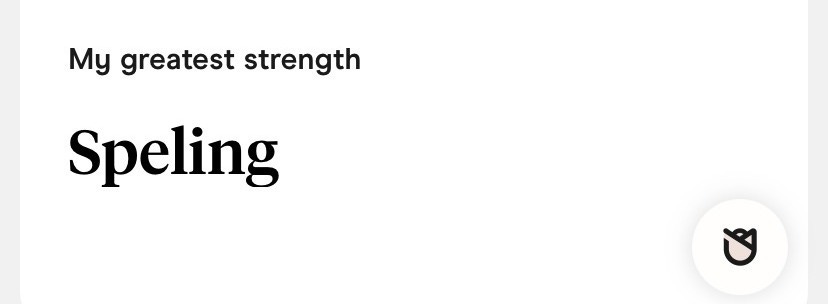
BUT, before you go cleansing your phone’s home screen of any dating app icons, this feels like the perfect point to instil some hope in all you male25 singletons reading, and declare: IT’S NOT ALL BAD.
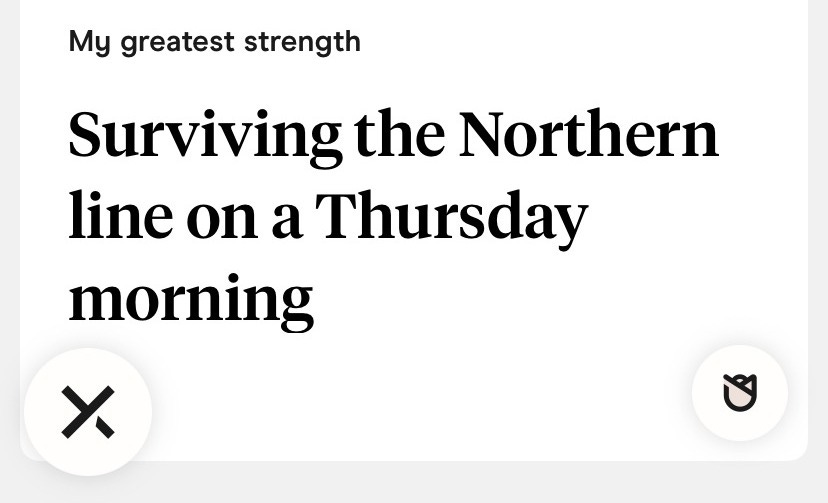
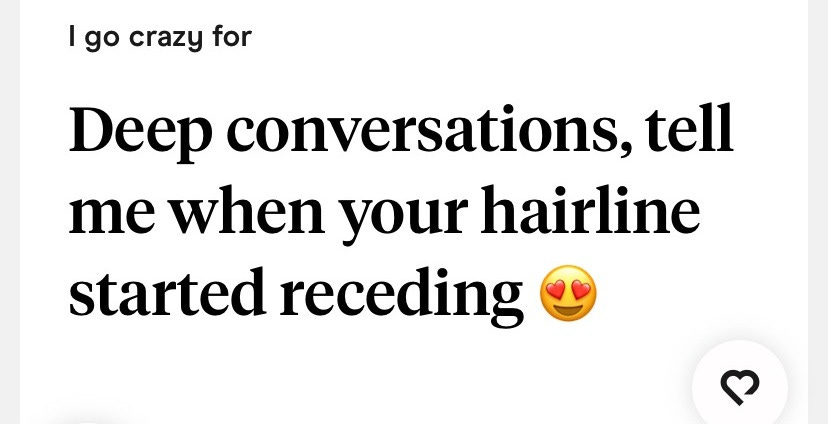
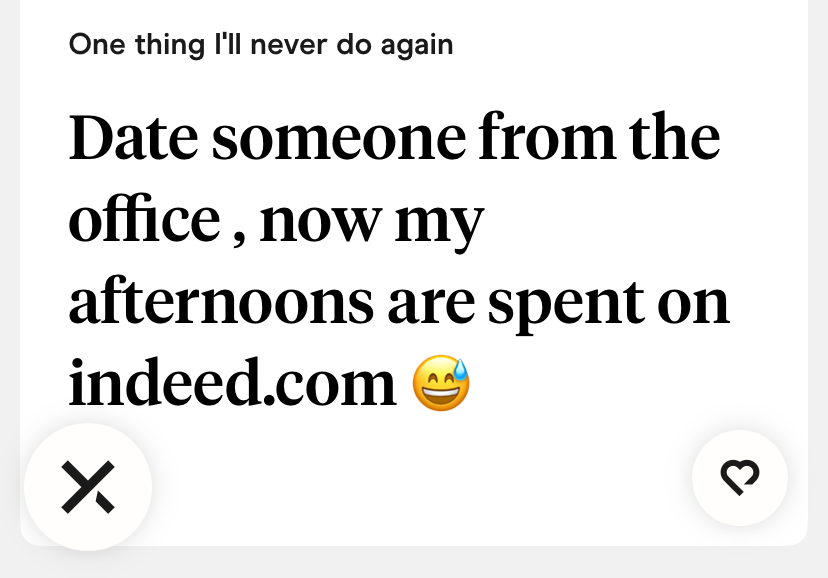
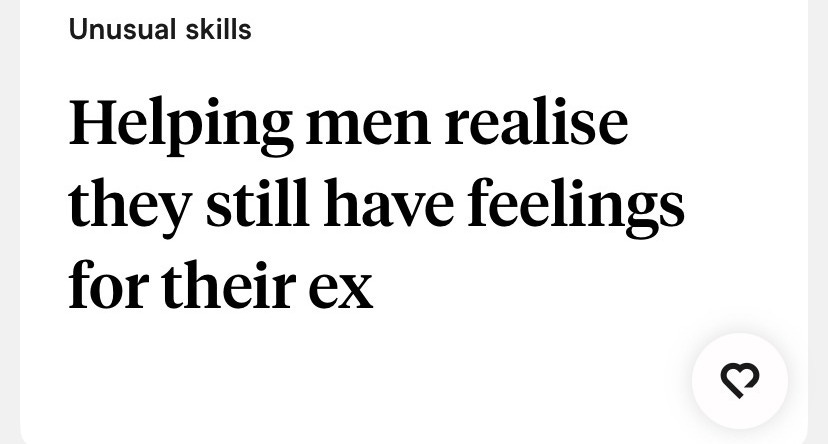
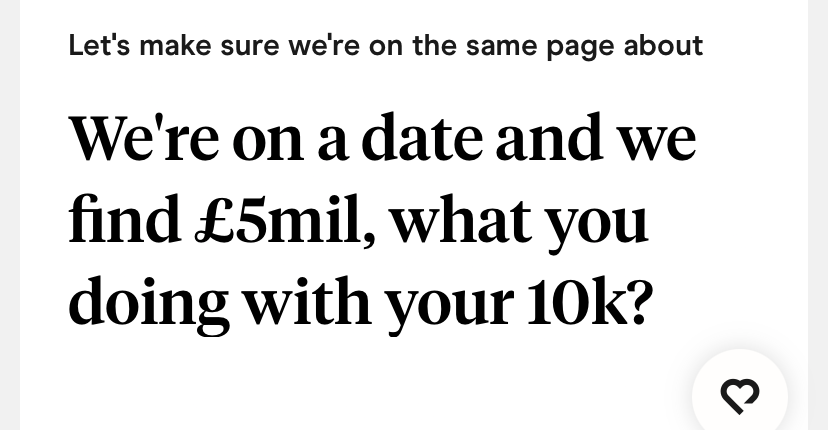
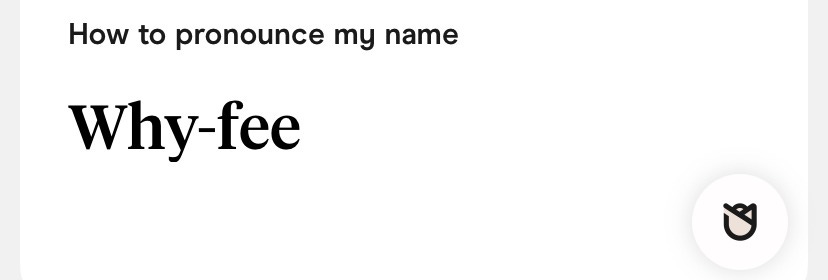
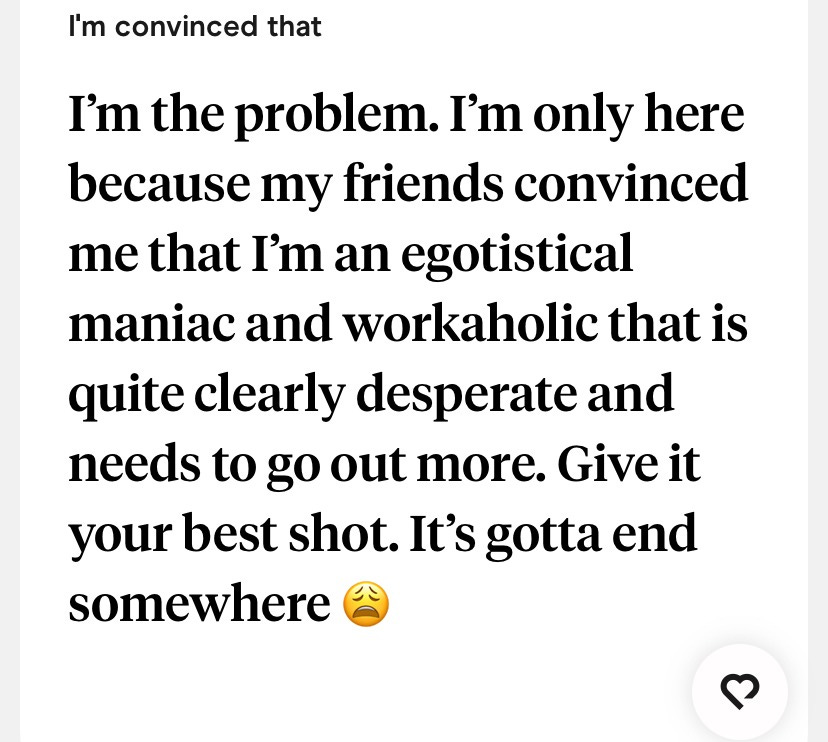
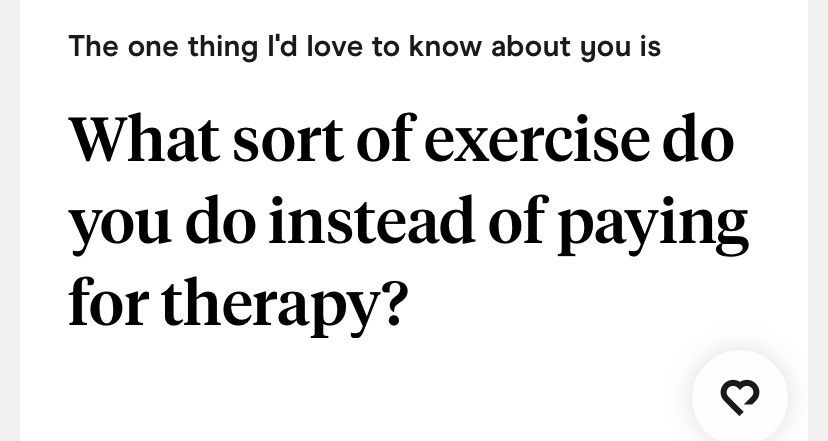
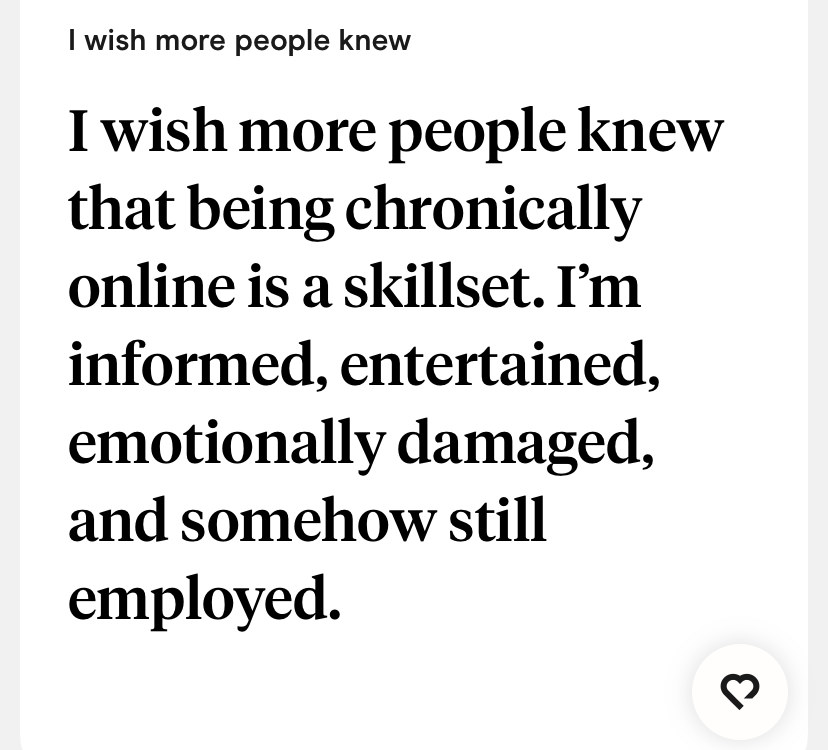
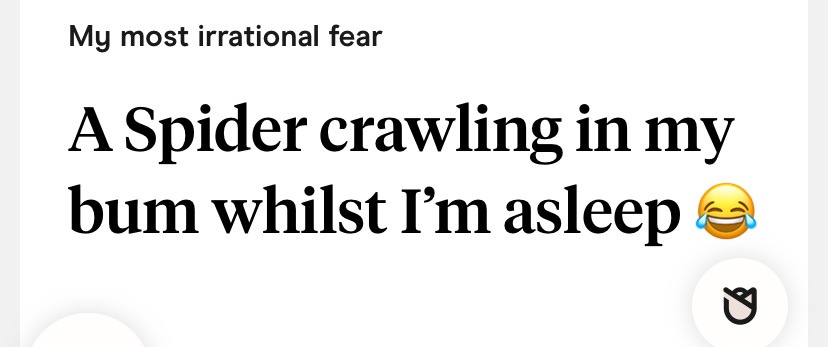
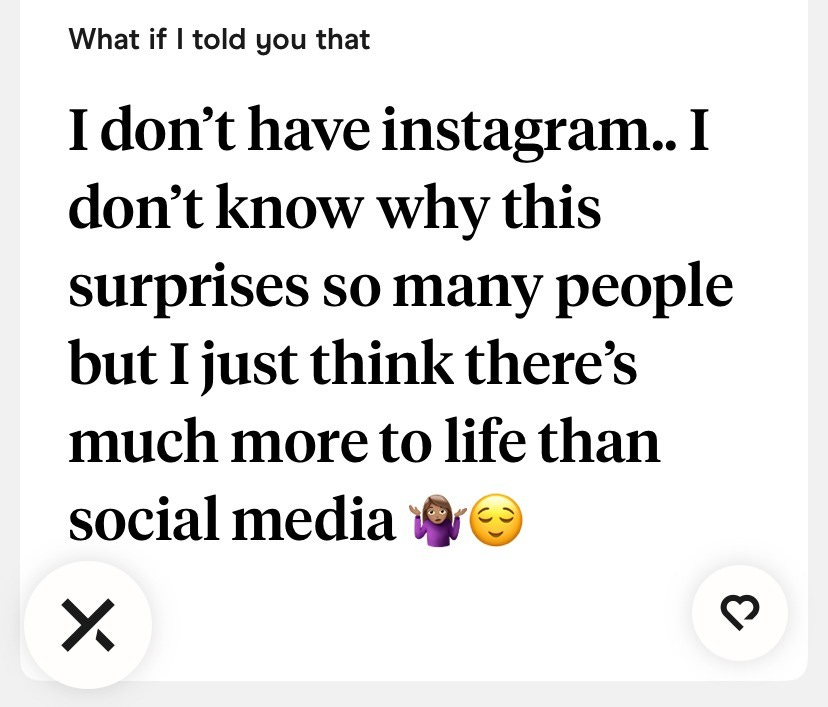
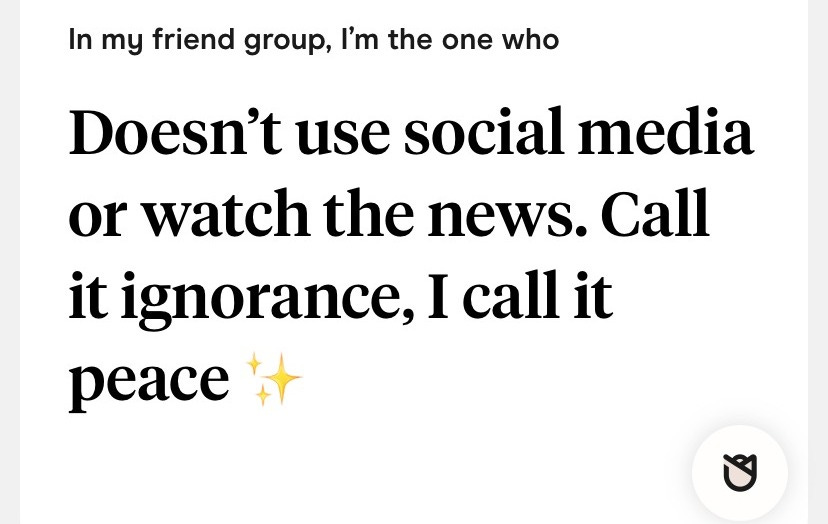
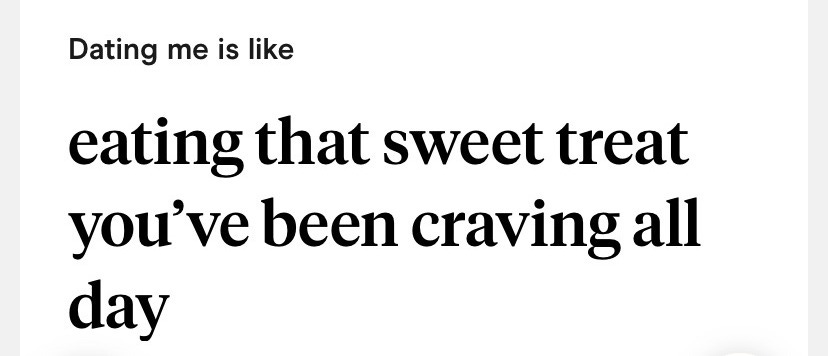
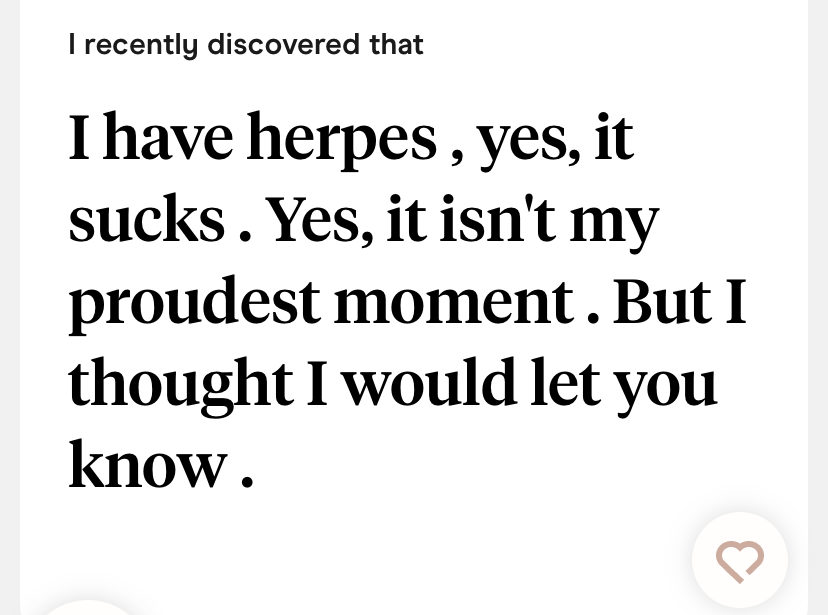
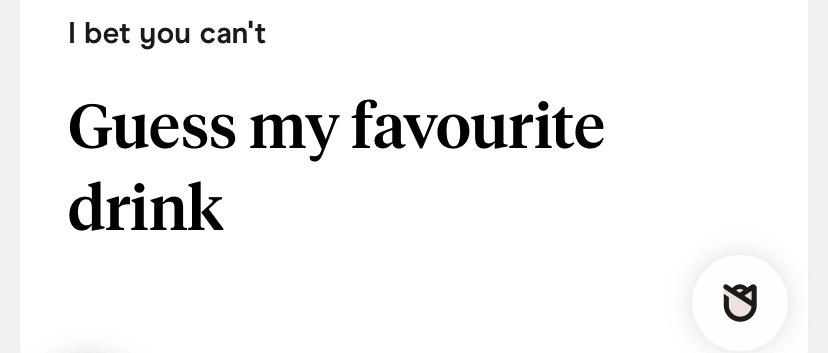
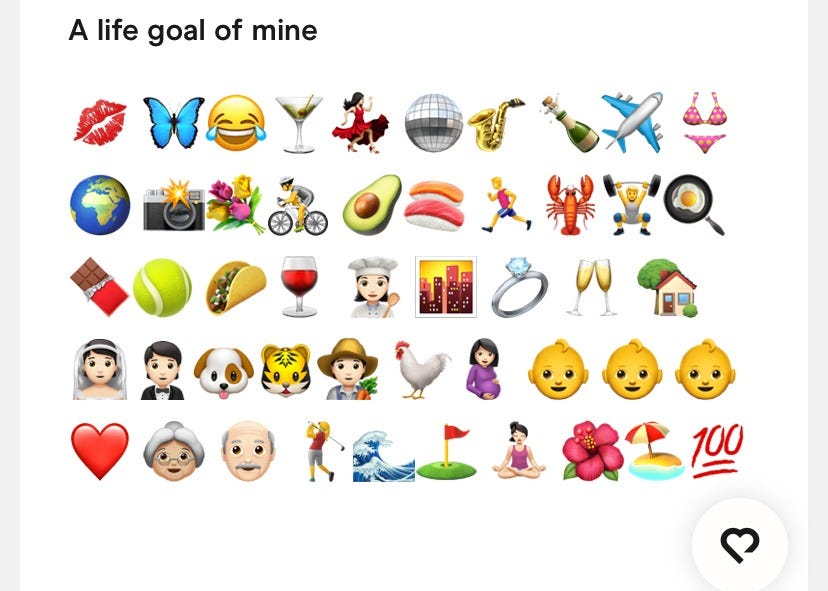
Yes, during my exploration into the online dating world, I can reveal that I did see the potential for some rough diamonds to be unearthed and cleaned up. For instance, here are some examples that prove there is still hope, and go a long way to dispel rumours that women aren’t funny.
Finally, What Tinder Taught Me concludes with a moment of introspection, as the investigation is directed inward:
After reflecting on this cynical discovery, I found myself looking at my own profile and found that I, too, had strategically uploaded pictures that displayed me in an ‘attractive’ light, I too had written a bio that inflated my own personality, and I too had succumbed to the shallow siren call of Tinder.
And with this, What Tinder Taught Me might have just touched on the biggest issue of online dating: to be successful in this environment, you must yield to the most egotistical and, arguably, least attractive aspects of human nature in an attempt to attract someone, which feels counterintuitive. And if you don’t want to, most will assume you’re either ugly, weird, or both. Sometimes, it feels like we don’t treat humans as if we’re human anymore.
Do you think we’re unintentionally demeaning ourselves through narcissism by creating profiles like this, and by dealing with other people in such a way that devalues actual human relationships? There’s little point in pretending that this behaviour is isolated to dating apps, as it intertwines with general behavioural trends within modern culture, with many avenues of contemporary life driving people to prioritise egotism. However, the way this is done in the digital era has become more complex as society continues to be shaped by its online counterpart.
Despite my seemingly pessimistic stance, I’m not against the option of relationships starting online, as I’m sure there’s plenty of successful situations that have begun this way, but for it to be the leading method of meeting someone feels a bit dispiriting—but only if viewed from a humanitarian perspective. In this age where humanity is being replaced politically, socially, and professionally, I feel compelled to support what keeps us feeling human for as long as possible.
In this context, DTF means ‘the taboo expression “down to fuck”: used especially in social media, text messages, etc to indicate willingness for a sexual encounter,’ according to the Collins English Dictionary.
Someone genuine please and I don’t like coffee
Art, music, beer, coffee, travel
I don’t take life too seriously
Harry Potter enthusiast
Intelligent, lover of cats, music, sloths, travel
Gin O clock
Life’s to (sic) short to live with regrets.. Remember what made u (sic) smile forget forget what hurt u and enjoy what makes u happy <3
*Stream of unrelated emojis*
My friends mean the world to me, travel means more.
I am not 20
Rest in paradise nanny&granddad my angels <3
If I could live in the 50s then I would…loves travelling
Wanderlust <3
Love my girls Sarah and Lianne <3
Got 9 tattoos and 6 piercings. Love travelling
Love music 50/60s…food is my favourite. Travellllll (sic)
Live life to the full. I meet amazing people and love to travel
A girl can be your best friend, your wife or your worst enemy…it just depends on how you treat her
Nurse, loves dancing and travelling the world.
Honourable mentions include:
Any reference to being a yapper or yapping — I don’t know why women think this is an attractive trait to men. I really don’t understand. I did smirk when someone said they were fluent in ‘Yapanese’, though. At least they were creative!
‘When I need advice, I go to…ChatGPT’. — I can’t emphasise enough how often I saw this, and how disheartening it is. Even if it’s a joke, it’s not funny.
e.g.
a statement by or photograph of someone on social media that is intended to attract attention or make people who see it sexually interested in them. — Cambridge Dictionary
There’s a lot to be said about how Instagram has, basically, become like a dating app, especially for those who use it primarily to post pictures/videos of themselves.
involving or relating to a connection between a person and someone they do not know personally, for example a famous person or a character in a book. — Cambridge Dictionary
Calm down, calm down. This is less a comment on the behaviour of women and more an observation of a societal decline in morality, using women’s behaviour in the context of dating as an example.
Remix | Look, we’ve all had our fun, but if we could stop sipping from the chalice of supposed female empowerment for just a second, we still might be able to taste the moral decency lingering in our mouths, before it’s washed away by another spicy margarita.
Those that are not are often referred to as ‘simps’.
Simp; someone who tries too hard to do what another person wants, especially in a romantic relationship. — Cambridge Dictionary
e.g.
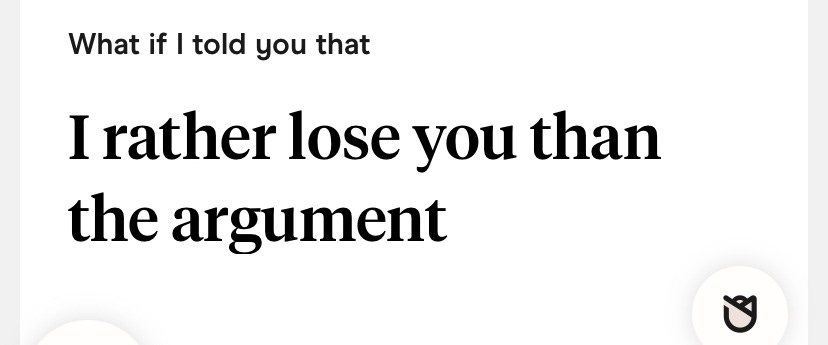
I’m sure there are some men out there who employ similar tactics, but, obviously, I don’t see them.
e.g.
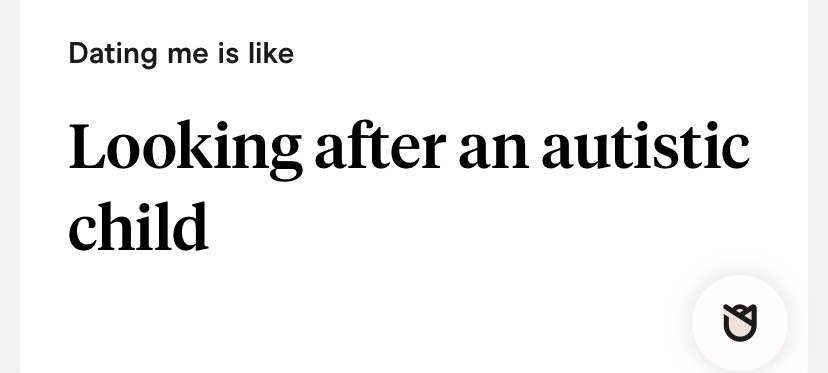
I felt obliged to show proof:
Ditto:
A woman told me about how she reluctantly began using a dating app due to a recommendation from a friend, who accurately described the experience as ‘like a card game’.
Gamification is the strategic implementation of game design elements and game principles in non-game contexts with the aim of enhancing user engagement, motivation, and behavioural outcomes. This interdisciplinary approach draws upon established principles from game theory, behavioural psychology, and user experience design to transform routine activities into more compelling and interactive experiences. — Wikipedia
‘What social media is, is the democratisation of the cult of self. Before, only the wealthy could enjoy the cult of self. Only the wealthy could take the time to self-indulge. But now, with social media, everyone can participate in the cult of self. That has led to a global epidemic of depression.’ — Prof Jiang Xueqin (How the Cult of Self Took Over the World)
Raya is a private, membership-based dating app that requires an exclusive application process for access. Unlike mainstream dating apps like Tinder or Hinge, users cannot simply download and create a profile; instead, they must be referred by existing members and then submit an application for review.
In decision-making and psychology, decision fatigue refers to the deteriorating quality of decisions made by an individual after a long session of decision-making. It is now understood as one of the causes of irrational trade-offs in decision-making. Decision fatigue may also lead to consumers making poor choices with their purchases. — Wikipedia
Some women have expressed the desire not to be bothered during their day-to-day lives (earphones/headphones are not just for listening to entertainment, but a physical DND signifier), but, paradoxically, they like the attention of being desired. See how some present themselves on Instagram, for example.
And even if you meet someone in person, more often than not, they will redirect your approach to their online persona.
Not to mention the risk of being deplatformed by the company itself.
In this context, see the Hinge ‘Most Compatible’ feature: ‘Based on your Hinge activity, we believe you have the best chance for a great first date. We found that, on average, you’re 8x more likely to go on a date with your Most Compatible than you are with any other Hinge member.’
Dating dictated by algorithms, and I hardly ever find the person suggested attractive. Also, AI tools, online shopping, self-service checkouts, etc.
Sorry, ladies. I hope, after reading from a male’s perspective, the women who use these apps in certain ways will better understand how they come across. I want a woman to write a similar essay on online dating from the female perspective, in a Frankee — F U Right Back-style reply.